Terahertz-driven control for ultrashort electron pulses with single-femtosecond stability
08 March, 2026
A compact THz structure integrates electron chopping and velocity bunching to generate isolated femtosecond electron bursts intrinsically synchronized to the driving THz field.
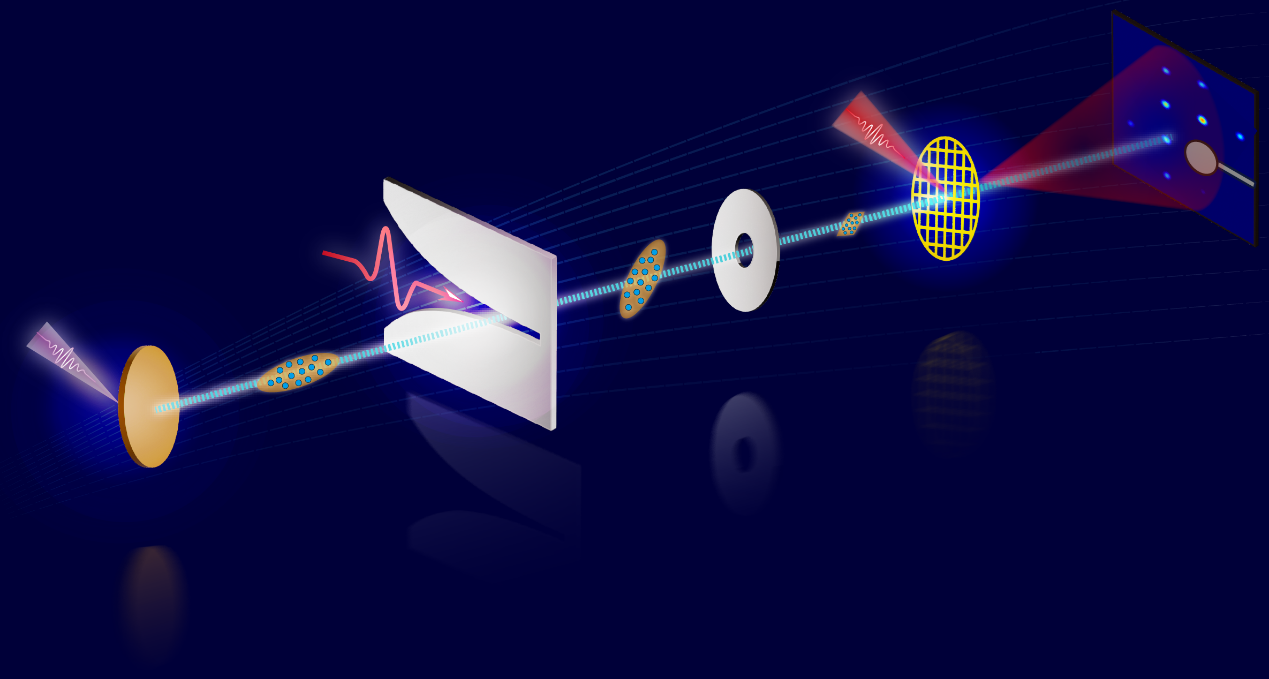
Ultrafast electron diffraction and imaging require electron pulses that are both extremely short and precisely synchronized to optical excitation sources. Although significant progress has been made in producing ultrashort electron pulses, achieving femtosecond-scale duration together with low arrival-time jitter in compact tabletop systems has remained challenging.
In a recent study published in Science Advances, a team of researchers from Shanghai Jiao Tong University, DESY and Universität Hamburg, led by Prof. Dongfang Zhang and Prof. Franz X. Kärtner, demonstrated a THz-driven approach that overcomes these limitations.
The key element is a compact THz-driven device that combines electron chopping and velocity bunching of the beam. Within the antenna structure, a single-cycle THz field generates near fields with distinct functions. A transverse deflecting field imparts a time-dependent momentum kick to the electron bunch, while a downstream aperture transmits only electrons near the THz zero-crossing, effectively performing temporal slicing. At the same time, a longitudinal field imprints a time–energy chirp on the transmitted slice. During propagation, electrons in the tail gradually catch up with those at the head, resulting in longitudinal compression and the formation of isolated ultrashort electron pulses.
Using this integrated scheme, the researchers generated keV-level electron beams with pulse durations of about 50 femtoseconds and arrival-time stability at the single-femtosecond level (1.4 fs). The compact architecture makes the approach particularly attractive for ultrafast diffraction and microscopy experiments requiring high temporal stability.
Beyond laboratory demonstrations, the THz-driven scheme enables compact and energy-efficient tabletop operation and can also be integrated into large-scale accelerator facilities such as free-electron lasers. Terahertz-driven electron control therefore opens new possibilities for ultrafast electron diffraction and other applications requiring extreme timing precision.
Reference
Ultrashort electron pulse generation with single-femtosecond-level jitter, J. Zheng, D. Su, X. He, F. X. Kärtner and D. Zhang, Science Advances (2026).
DOI: 10.1126/sciadv.aec0008